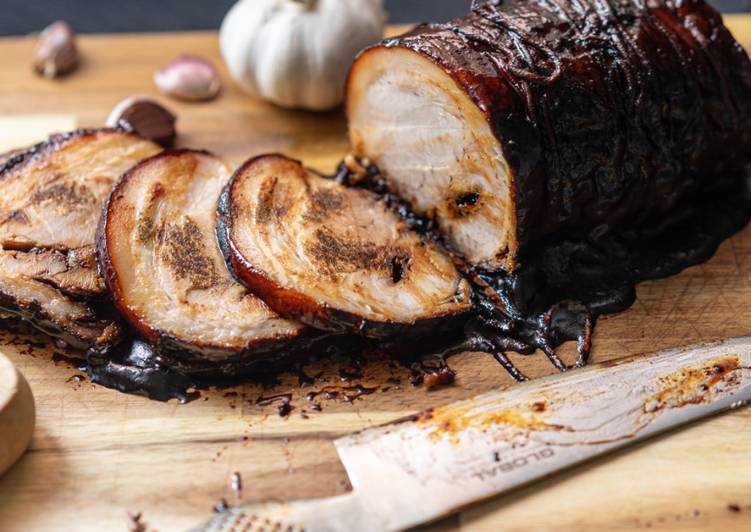
Hello everybody, hope you’re having an amazing day today. Today, we’re going to make a distinctive dish, homemade japanese chashu (braised pork). One of my favorites food recipes. This time, I am going to make it a bit unique. This will be really delicious.
In Japanese, Chashu is sometimes called "Nibuta" (煮豚), literally means simmered/braised pork, as opposed to "Yakibuta" (焼豚), which means barbecued pork. The Japanese enjoy Chasu as a topping for Ramen and other noodles, as well as Chasu over steamed rice in called Chashu Don, like a rice. Full recipe: www.xkindeep.com Instagram: www.instagram.com/opps_itseli A bowl of ramen is incomplete without this sensational topping, The Japanese Chashu. Make fresh restaurant-style Japanese chahsu pork ramen with our recipes for both braised pork belly chahsu and roasted pork shoulder chahsu.
Homemade Japanese Chashu (Braised Pork) is one of the most popular of recent trending foods on earth. It’s enjoyed by millions every day. It is easy, it’s quick, it tastes yummy. They’re fine and they look fantastic. Homemade Japanese Chashu (Braised Pork) is something that I’ve loved my entire life.
To begin with this recipe, we have to prepare a few components. You can cook homemade japanese chashu (braised pork) using 14 ingredients and 24 steps. Here is how you cook that.
The ingredients needed to make Homemade Japanese Chashu (Braised Pork):
- Make ready Meat
- Take 1 KG Square slice of Pork Belly
- Take 3 TBSP Cooking Oil
- Prepare Marinating Sauce
- Make ready 1 Cup Dark Soy Sauce
- Prepare 1/2 Cup Brown Sugar
- Make ready 1/2 Cup Sake
- Prepare 3 Cups Water
- Get 3 Stalks Spring Onions
- Take 20 G Ginger
- Prepare 2 Cloves Garlic
- Take Others
- Take 1 Ball of Cotton String
- Make ready Salt
They don't look anything alike because they aren't: char siu is roasted, whereas. This Japanese adaptation of the Chinese dish char siu is seasoned with sugar, sake and dark soy sauce and braised at a low temperature for a few hours. Chashu (Braised Pork Belly) recipe for topping of tonkotsu ramen noodles. It could also be used in rice saute, fried noodles or pizza topping.
Steps to make Homemade Japanese Chashu (Braised Pork):
- Rough cut ginger with skin on
- Cut spring onions into halves
- De-skin garlic
- Add all marinating sauce ingredients into a saucepan
- Bring it to boil, stir and turn the heat off immediately
- Use coarse salt to clean & exfoliate meat
- Rinse the salt off with clean water
- Roll pork belly into a log
- Tie up rolled pork belly
- Pan-fry rolled pork belly for 2 mins per side until it's golden brown
- Put fried rolled pork into boiling water for 1 hour
- Remove pork belly from boiling water
- Pour marinating sauce into a shallow pan deep enough for your pork
- Heat up marinating sauce to boil
- Once it's boiling, turn the heat down to the lowest
- Add pork into pan and cover it with a drop lid or seal it with an aluminium foil, and make a small hole in the middle.
- Braise each side for half an hour (Total 2 hours)
- Transfer braised pork into a ziplock bag
- Use a strainer and strain remaining sauce into the ziplock bag
- Squeeze the air out and seal it tight
- Store it in the refrigerator overnight or 24 hours to marinate
- Remove braised pork from the ziplock bag
- Slice it thinly
- You may choose to blowtorch or pan-fry it to bring out the smokey taste.
Chashu (Braised Pork Belly) recipe for topping of tonkotsu ramen noodles. It could also be used in rice saute, fried noodles or pizza topping. I will post series of ramen (Japanese noodles) making for the next few days. This chashu pork (pork belly braised in soy sauce, sake, and mirin) is the perfectly tender addition to your next bowl of ramen. Chashu is one of the basic and most popular toppings found atop ramen.
So that’s going to wrap it up for this special food homemade japanese chashu (braised pork) recipe. Thanks so much for your time. I am confident that you will make this at home. There is gonna be interesting food at home recipes coming up. Remember to bookmark this page in your browser, and share it to your family, colleague and friends. Thank you for reading. Go on get cooking!